
The Herschel Story
An Interdisciplinary Music, Science and Heritage Project
Project Overview
Orchestra of Square Chapel are planning a unique event which will take place at Halifax Minster on Saturday 11th September 2027. The performance will tell the remarkable story of William Herschel (1738-1822) – first organist at Halifax Minster – and his sister Caroline Herschel (1750-1848). Orchestra of Square Chapel will present a selection of William Herschel’s music. Two narrators will play the parts of William Herschel and Caroline. Between the musical items, the narrators will tell the story of the Herschels, drawing on Caroline’s extensive diaries, whilst further information, images and videos are displayed on a large screen. The audience will be invited to help to build a large model of William’s 40ft telescope during the performance.
Artistic Concept
The show will trace William Herschel’s extraordinary journey from humble bandsman to successful composer and internationally celebrated astronomer. Central to the project is the idea that music, science, craftsmanship, mathematics, and Enlightenment thought were deeply interconnected disciplines rather than separate worlds.
Equally important is the role of Caroline Herschel, whose achievements as a singer, musical assistant, astronomer, mathematician, and scientific collaborator were pioneering. Caroline Herschel became the world’s first professional female astronomer and was awarded the Gold Medal of the Royal Astronomical Society. Narration throughout the performance will draw on Caroline Herschel’s voluminous diaries, allowing audiences to experience the story through contemporary voices and perspectives.
Musical Programme
Orchestra of Square Chapel will be joined by soloists David Baker (organ) and Trudy Mansfield (oboe) and conducted by Stephen Threlfall.
The works to be performed will be:
- Herschel: Symphony No. 13
- Organ solo: The Old Hundredth
- Herschel: Oboe Concerto No. 2
- John Johnson: Two Dance Tunes
- Herschel: The Eccho Catch
- Herschel: Organ Concerto No. 1
- Herschel: Symphony No. 20 in C major
- Haydn: The Creation: The Representation of Chaos (We believe that this work may have been inspired by Haydn’s visit to the Herschels in 1792.)
Background
William Herschel (1738-1822) started his musical career as a bandsman in the Hanoverian Guards, before becoming a successful composer, arranger and soloist working in the north of England. He was appointed the first organist at St John the Baptist church (now Halifax Minster) in 1766. This was soon followed by his appointment as organist at the very prestigious Octagon Chapel, Bath. He composed 24 symphonies as well as many concerti and smaller pieces. His work was supported by his sister Caroline and his brothers Jacob and Alexander.
All the while William Herschel maintained a keen interest in astronomy, and whilst at Bath started to build his own telescopes. Assisted by his sister Caroline, his breakthrough was the discovery of the planet Uranus, which paved the way for his appointment as “King’s Astronomer”, allowing him to retire from his musical activities and devote all his energies to astronomy.
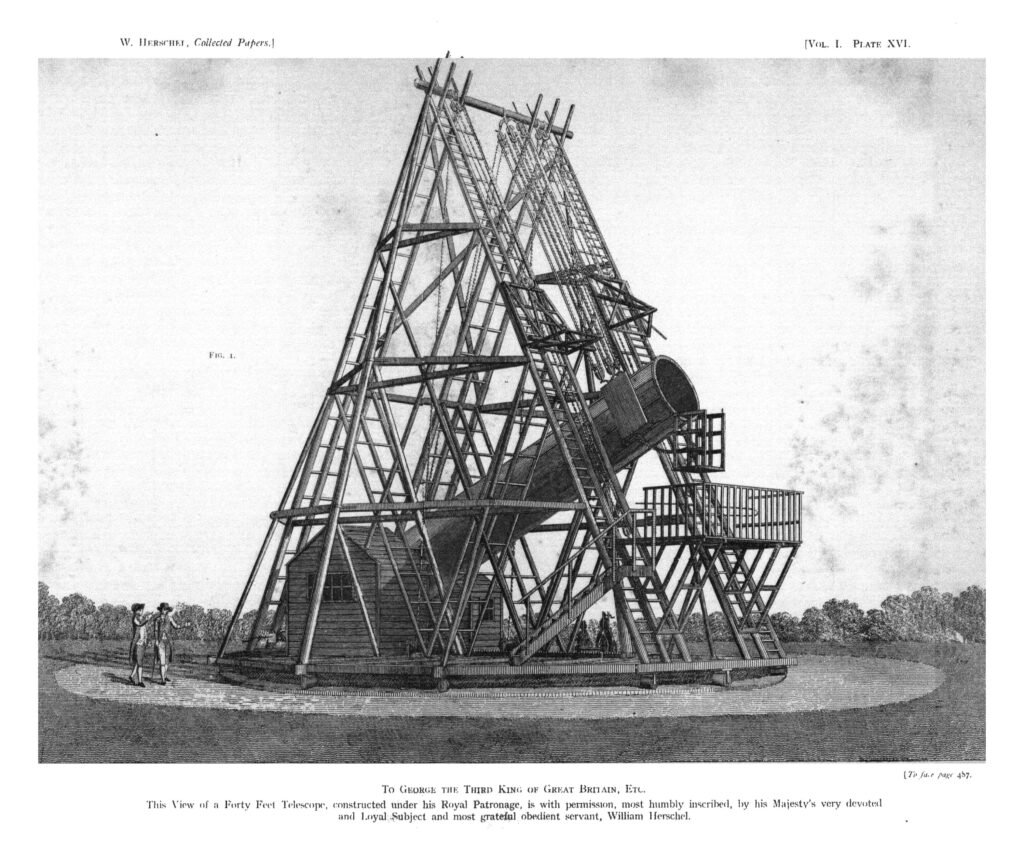
His “Forty Foot Telescope” was the largest scientific instrument in the world, and William Herschel became one of the most famous people on the planet. Heads of state and dignitaries from all over the world queued up to visit.
William Herschel was a remarkable man and his achievements were many. In the field of music, he quickly established himself as a leading composer and was also able to perform at the highest level on violin, oboe, organ and harpsichord. He maintained a constant passion for science and showed his understanding of the physics of music in his unpublished book, Treatise on Music. Mastering the science of optics, he designed his own type of telescope and went on to build a succession of instruments culminating in his famous forty-foot telescope. He sold a large number of telescopes to scientists and members of the nobility worldwide. Herschel published numerous scientific papers and became a member of the Royal Society and first president of the Royal Astronomical Society. His practical skills included the design and fabrication of all the woodwork and metalwork required, producing detailed drawings and written plans, with every aspect of the process supervised by Herschel himself.
Working alongside him throughout, Caroline Herschel took leading singing roles in many of Herschel’s musical enterprises, also writing out the parts for many of the pieces and training the choirs as required. She took on an important role as his assistant in all the scientific work, writing down all the astronomical readings, writing up his scientific papers and carrying out all the required calculations. Her work as an astronomer continued after William’s death, and she was awarded the Gold Medal of the Royal Astronomical Society in recognition of her pioneering work. Receiving a salary from King George, Caroline became the world’s first female professional astronomer.
Conclusion
The Herschel Story offers a unique opportunity to explore the interconnected worlds of music, science, craftsmanship, and Enlightenment culture through the lives of William and Caroline Herschel. Combining live orchestral performance with historical storytelling, visual media, and audience participation, the project aims to create an accessible, intellectually engaging, and culturally significant public event.
By reconnecting Halifax with an important aspect of its own cultural history while addressing wider themes of creativity, discovery, collaboration, and innovation, the project seeks to bring new audiences into contact with both classical music and the history of science in imaginative and memorable ways.
Meet the team
Nick Barber
Founder member and Chair of Orchestra of Square Chapel, Nick has been responsible for setting up the project. Initially the idea was simply to present another orchestral concert, but to feature William Herschel’s music. This has grown into The Herschel Story, and to facilitate this, Nick has involved an impressive team of experts and performers…
David Baker
A nationally-known performer, teacher, publisher and scholar – specializing in all things organ-related, David Baker will be the organ soloist in our performance of Herschel’s Organ Concerto No. 1, as well as advising the team on a range of musical and historical matters.
David Shuker
Research chemist turned organ builder and restorer, David Shuker runs Sign of the Pipe Books and Music as well as Orgelkids. An expert on the history of English pipe organs, David has a long-standing interest in William Herschel and his music.
Karin Barber
A cultural anthropoligist and former professor at Birmingham University, Karin has advised and assisted with the production of the script for The Herschel Story.
Thom Meredith
Well-known as baritone singer, conductor, arranger and choral leader, Thom is a former Principal at Musica Kirklees. In The Herschel Story, as narrator, he will play the part of William Herschel as well as singing The Eccho Catch.
Rowena Burton
Rowena has worked as a soloist with Orchestra of Square Chapel and Huddersfield Philharmonic Orchestra. In The Herschel Story she will, as narrator, take the part of Caroline Herschel.
Susan Edwards
Susan Edwards is no stranger to the solo concerto platform, having performed on many of London’s major concert hall stages and from Spain to Romania, with Vivaldi Concertante and the London Schubert Players. Susan will perform the solo part in the first movement of Herschel’s Oboe Concerto No. 2 as part of The Herschel Story.
Daniel Baker
Daniel Baker is a craftsman and producer of hand-crafted, high quality furniture. He has undertaken the task of building a large (1/6th scale) model of Herschel’s 40ft telescope for use as part of our performance.
Mary Barber
Leader of Orchestra of Square Chapel, Mary Barber will work with our conductor and soloists on tempo, bowing, phrasing and musical interpretation.
Stephen Threlfall
As Orchestra of Square Chapel’s conductor and Musical Director, Stephen will conduct and direct our rehearsals and concert.
More
Herschel’s detailed description of the telescope.
The 1/6 size scale model is under construction!